I don’t think that schools or learning will ever be the same again, because right now, what students need from a teacher to meet the current measure of efficacy (via performance metrics) by schools is going to be easily and equitably surpassed. The technology exists, but it in turn raises questions over what we recognize as the purpose and desired products of schooling.
I’m going to be honest, even despite the hype of AI (not just since 2023 but like, goddamn since much earlier) have I been seeing people auto-felatiate over AI generated slop images and content as thought it were 1) even definitionally Artificial Intelligence, or 2) producing from a human anthropological standpoint any single actual artifact which contained value. This hasn’t really bothered me too much, nor had it become marginally tempting to consider as a toy for me to use until 2024 when many things became freemium and accessible to even most grandmas and five year olds. I didn’t immediately hop onto the train, though I was aware of the potential for ChatGPT to complete or assist with completing homework, but I did indeed eventually employ it for one class where I needed that sort of help, and believed that I could use it as a resource to teach myself like some had advertised.
Learning Calculus with ChatGPT
The only reason this is a story is because I have been “not a math person” for my entire life (aka conditioned by school to not mature skills which were likely foundational neglected) and I expected calculus to be difficult. Not only was it not difficult, but it was the easiest class of that quarter, and I found that I only had to commit to attending the classes and roughly 10 hours of independent studying per week. This was not because of the professor though. The professor was terrible, and maybe deserves to be given a promotion to retired respected alumni sometime soon so that another teacher could be offered. I had no help from friends in that course, nor did I attend a study group. It wasn’t that I didn’t struggle though; I simply found myself learning at a pace which was not challenged by the course.
I’m not going to spend too much time on this, for two major reasons:
- It was almost two years ago now that I did all this inquiry ,and it was squashed in between two other difficult courses and two research assistanceships. I can summarize and that’s about it
- It was largely a playground experience, of learning how prompting gives a wide variety of results, and why the user can often be their own worst enemy (if you want to agree with yourself, open up ChatGPT). I spent half of the time prompting it with silly things like “tell me what my D&D character should wear based on these fashions and colors”.
It was excellent- it far exceeded the teacher in quality, and it oftentimes out-paced the teacher without meaning to because it’s explanations were so flowing and easy to understand that I could find myself using the logic that I was gaining to think about the rules of the area of content in order to design questions which challenged the logic or asked the inverse of principles, which in turn led to learning about new topics and principles earlier than the class would proceed with (or ever get to, there was a good amount of calculus that I ended up learning that would be expected in a calculus class which this teacher never got to, for better or for worse).
What was kind of brain-breaking was when I put my direct notes as pictures into the chat, when I was agonizing over the inscrutability of the professor’s writing on the monitor, and I was able to get both translations and educational content summaries of what was being referenced in those pictures, so that within minutes I could generally always get back on track with a class if ever I became hopelessly lost. I could show it 10 scratch marks next to a distribution and an equation and it could tell me exactly about the principle which was being explained, and also it’s relevance to the rest of the material, which the professor was pretty much failing to do for the entire class population.
So it’s kind of like a textbook. But it’s a textbook which can tell (with prompting) when you’re not paying attention and snap your eyes back to what was central, and what may have been missed or passed over, and uses its infinite patience to wrestle through all of it with you.
But on top of this, it can also infinitely quiz you. (nowadays it can quiz you with 100 different visual mediums and interactive games/websites)
So what did I use it for? Well, other than all of the above I also used it to create questions for me which test in the same way the professor does, in order to best predict the misunderstandings I’ll encounter on the real test because of the uniqueness of the professor’s verbiage/preference for rules/explanations. I was able to do this by just recreating the midterm questions from memory on a sheet of paper and giving the images to ChatGPT. Mind you, this was in spring of 2024, so it hadn’t even popped off yet.
Learning R, RStudio, and MPlus via ChatGPT
So it can master coding syntax about as well as it can master english syntax, which is to say just about 99%, and in almost every way better than a human. It obviously can make many mistakes, the largest related to intuition or properly interpreting the intentions of the prompter, but this is where I began to develop an understanding of what new learning for future children would also include: knowledge of how to gain the information you’re looking for via lines of inquiry in knowledge engines equivalent to prompting. Children would have to have a knowledge of the value of being accurately vs. inaccurately informed and develop a sense of knowledge vigilance, where their trust to people who they don’t immediately identify as safe such as family is unfortunately vastly impacted by the knowledge and learned culture that misinforming you is both beneficial and at times strategic by chat agents and also malicious entities, generally. This has a lot of implications for the safety and principles we teach our children in the near future which are kind of scary, but it’s just a single instance of byproducts, most of which are yet still unforeseen. We just don’t know for certain what’s in store but there will no doubt be practice in school which train children to scrutinize the content which they consume to know how relevant or accurate it is to their world, and how to best interpret it in a world where content whips around every person at a whirlwind rate.
How is this about learning to code? Well I only managed to learn to code (for an honors thesis project which is still ongoing) in Summer of 2025 and only as a result of painstaking learning of much of these principles, of how to constrain an agent with such a vast collection of networks to think in the exact same way that I do, or much more often in the exact same time a rigid and intelligent researcher would. Not only did I need to be able to learn code to learn how to accurately demonstrate something in a statistical quantitative test, but I was ambitiously aiming to demonstrate specific interactions which I would have to see and then argue and then demonstrate which no one had done before. And so I didn’t have a 24/7 tutor to help guide me with the specifics of these super niche statistical tests, nor a quantitative researcher to really understand and guide the methods and processes of my developing inquiry to be research appropriate and within the expected leaps a researcher can make in a single study, but this did nothing to stop me from doing it regardless
Chat, with a lot of learned knowledge of how to prompt, how to facilitate sourcing and also requiring researcher executive-style review/judgment/critical perspective in all responses, I was able to mentor myself. I was able to teach myself all of the critical components, and understand the process start to finish, and proceed with the writing of the manuscript having confidently completed my results output (after it kicked my ass for 16 straight weeks).
I picked up books from the library almost every day for reference in order to do this, I asked authors for their sources (and sometimes advice), and I used citations to concretely ground my arguments which I’d hoped to demonstrate via quantitative analysis. I worked real hard, and I used AI to help me learn a lot more than I ever could have alone, and what was most noteworthy was how quickly I was able to do it, all alone. I was committed, so it would likely take someone less motivated longer than 3 months, but only requiring June to the end of August to take data as a mostly unexperienced research assistant undergraduate and produce not just one but ten sets of statistical analyses and know exactly how to present them as data is fucking noteworthy.
The real reason I want to talk about AI: Gemini, Nano Banana, NotebookLLM
Here’s some .html files which should teach you a couple things about research processes, which I created with the help of Gemini with the Pro version (free for a year for students)
Here’s a visual which explains the qualitative data analysis that I conducted using AI as the main analysis tool:
Here’s a visual which explains what the content of that collective group of analyses including the final main evaluation document contains, in summary of the program which is in study:
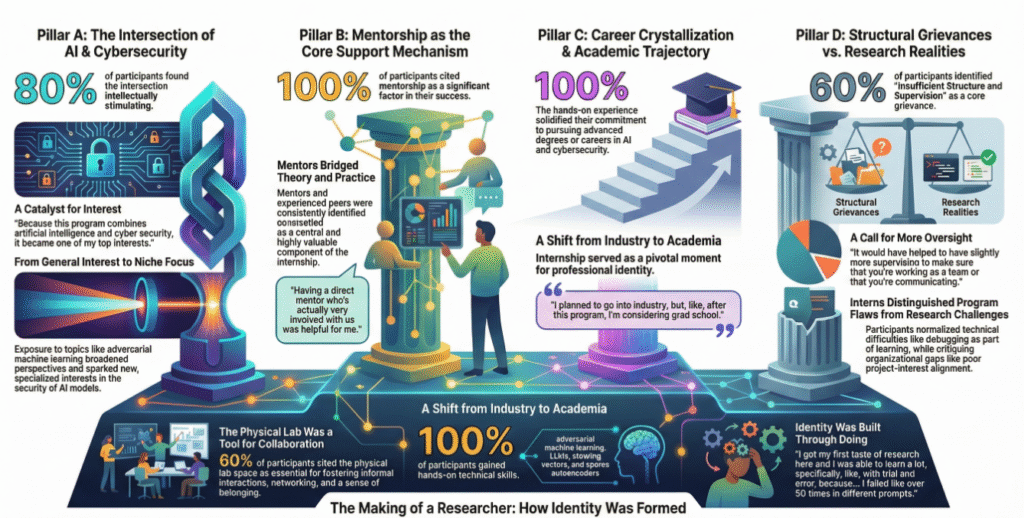
And each of these took me running sources (sources which didn’t contain any live data, mind you, just results) through the engine called NoteboookLLM and waiting a couple minutes.
I have mentees who are undergraduates who are writing abstracts for research reports right now who can use sources relating to rules and principles for writing an abstract and be able to create for themselves fully detailed infographics cheerfully visualizing exactly how they should care and put attention to each component and then bring them together.
It is a device which can create excellence as though it were a particle accelerator shooting around atoms at speeds which cannot be fathomed. It can accelerate us if we chose to use it to become smarter, and not lazier. But how do we navigate this? What if others unlike me are more preferably lead to think up cleverer prompts which allow them to get away with doing less of the work? What about using “intelligence” to compare humans to one another? Well okay the last one is just a myth haha.
Dec 2025 WestEd Seminar presented by Becah Busselle and Patrick Moyle
So it seems to be in some ways valuable to learning to some people under the right circumstances given correct prompting and guidance in terms of logic/rationing. Perhaps it is reaching a curve (Tate’s words), or perhaps not, but here’s what some feel it can already accomplish/navigate now.
I think it contains a lot worth thinking about. I even think that students including children could use AI as it stand today, right now, to turn this document into a learning resource which helps them clarify how to use and not abuse the agents as allies and not cognitive shortcuts.
So yeah, just a couple things to think about based on some of the more cutting edge experiences I’ve had. This is not even talking about the paid research agents that I’ve been paid to use and analyze feasibility of use for in the realm of academic professional research, (not naming names, but they should be ashamed) which has similarly stunning possibilities entailed for 1) making entire start-to-finish procedures (based on theses and frameworks alone) which are consistently rock solid and most conservative in terms of resources and effort, and 2) assisting with quantitative or qualitative analysis, either by guiding quantitative methods or by successfully engaging in thematic analysis for qualitative data.
It has a lot going for it, and I really hope that the most ingenious people currently living in places like America which have access to freemium versions of these models use it to educate themselves far far beyond what any college education or college educated person could do for them, because of what a great socialist liberatory tool it may present as.
Because of this we need to recognize that the shifting landscape which is beginning to make manual labor in many industries obsolete (and also many professions, such as small farming) and also reinventing what it means to demonstrate “ability” or “performance” to output effort, because barriers to entry to create incredible things is getting lower and lower. We need to find more resourceful ways to value our students. my suggestion? Community Cultural Wealth framework.
Tate Universe
Leave a Reply